|
Broadford is a Village in the central area
of the Isle of Skye, 7 miles north of the
Skye
Bridge, 26 miles south of Portree.
Broadford is the second largest settlement on
Skye, after Portree, popular for its Market,
where Drambuie was first made at the Broadford
Hotel, and Accommodation as it is well situated
for exploring the whole Island.
For Images on Mobile swipe right.
Click on Map Area Attractions
Attractions
List Postcode: IV49 9AE
Camping & Touring Parks in
area
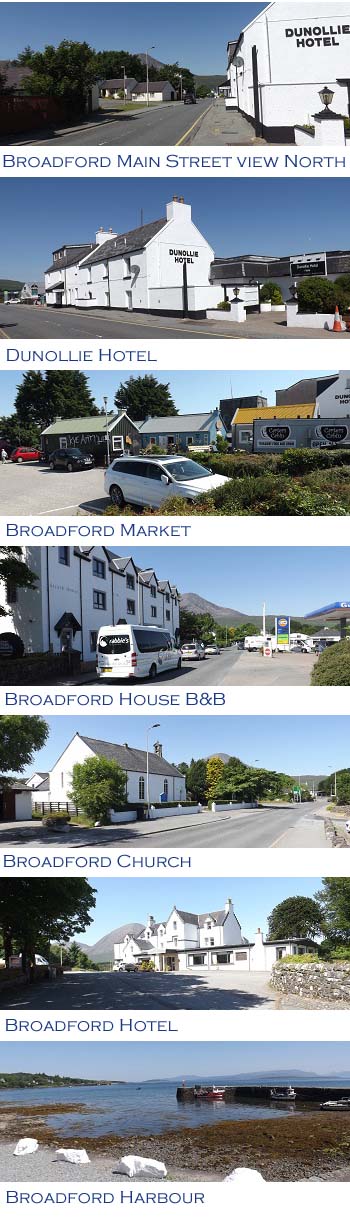
The top image is looking north along the
Main Street. This is the main road that runs
north from the Ferry port village of Armadale and
the Skye Bridge to Portree. The Mountain in the
distance is the 732m / 2,402ft Beinn na
Caillich, known as a Red Cuillin.
Many of the mountains on the east side of
Skye are reddish with dome tops. Mountains in
the central area are darker with pinnacles,
known as Black Cuillin's. A number of the Black
Cuillin's are over 3,000ft, attracting vast
numbers of hikers and climbers from around the
world.
The second image is of the Dunollie Hotel
in the centre of the village.
The third image is of the Isle of Skye
Market Square on the Main Street. There are a
number of interesting Little Shops.
The fourth image is of Broadford House Skye
B&B, also on the Main Street.
The Broadford Hotel is at
the north end of the Village where a minor road
leads west to the scenic village of Elgol and Spar Cave
on the west coast, popular for boat trips. The
Hotel is famous as the place the liqueur
Drambuie was developed.
Broadford Harbour is behind the Market
Square and Dunollie Hotel.
Broadford History
600s - St Maelrubha preached at a site 4
miles west of Broadford.
800s - Vikings gained control of Skye and
most other islands in Scotland, giving this
area the name Broad Ford, a Wide Bay.
1100s? - At Beinn na Caillich mountain, in
Glen Suardal, just north of Broadford, Clan
MacKinnon from Skye, is said to have defeated
the Vikings in battle.
Clan Mackinnon then controlled this area
with Castles at Dun Ringill 18 miles west of
Broadford, and Caisteal Maol at Kyleakin 12
miles southeast of Broadford, both now
ruins.
1100s - the Vikings were forced out of the
Western Isles by Scottish Kings. Scots Clans,
loyal to the Kings, were used to gain, and keep
control of the areas once held by the
Vikings.
A Church was built where St Maelrubha
preached after this time.
1500s - Kilchrist Church was built to
replace the earlier Church where St Maelrubha
preached to serve the Broadford area.
1611? - the Broadford Inn was built at the
north end of the Village for Traders and
Travelers.
1698 - first records are made of Marble
being Quarried in this area of Skye.
1700s - Broadford had a Cattle Market with
Cattle from around Skye taken there by Drovers
Trails.
Large herds of Cattle were then made swim
across to the mainland, then walk 160 miles
southeast to the main Cattle Market in Scotland
at Crieff.
1746 - Bonnie Prince Charlie was helped by
Captain John MacKinnon of Skye to flee Scotland
after the Jacobite defeat at the Battle of
Culloden. In return, Charlie gave MacKinnon
a recipe for his personal liqueur made from
Brandy, honey, herbs and spices. The
MacKinnon's then began making the liqueur for
themselves.
1700s late - the MacKinnon's were forced to
sell their land on Skye to pay off debt, with
many Clan members then relocating to the
mainland or emigrating to Canada, United
States, and Australia.
1812 - Thomas Telford built a road from
Portree to Kyleakin, passing through Broadford.
Kyleakin is where ferries ran before the Skye
Bridge was completed in 1995, the shortest
crossing to the Scottish mainland about 500
yards, also where the Cattle swam across.
1800s - Veterans of the Napoleonic Wars
settled in Broadford, with an area of the
village named Waterloo.
1800s - marble was Quarried at the Beinn na
Caillich Hill on the northwest side of
Broadford.
1840 - the Broadford Hotel was built at the
north end of the Village, on the site of the
Broadford Inn from the 1600s.
1841 - Broadford Parish Church was built to
replace Kilchrist Church.
1880s - James Ross ran the Broadford Hotel,
where he developed the liqueur the MacKinnon's
had been making for over 100 years, by mixing
Scotch whisky, honey, herbs and spices. Ross
named the liqueur Drambuie, meaning in Scots
Gaelic, the drink that satisfies.
1893 - the name Drambuie was registered as a
trademark.
1904 - a Railway was built to carry Marble
to the Pier at Broadford.
1907 - the company named Skye Marble was set
up, expanding Marble production and
Exports.
Skye marble is claimed to have been used in
buildings such as Armadale Castle, Iona Abbey,
Hamilton Palace by Glasgow, the Vatican in
Italy, and Palace of Versailles in France.
1910 - 1914 - a steam locomotive named the
Skylark was operated on that line.
1909 - production of Drambuie began
in Edinburgh, soon being sold around the
world.
|