|
Dunnet Head is 121 miles north of Inverness, 15
miles west of John O
Groats.
Dunnet Head is the furthest North Point in
Scotland. John O Groats is the furthest north
Village, and Duncansby Head is the furthest
northeast point. Dunnet Head is now a Nature
Reserve that can be visited any time free of
charge. Postcode: KW14 8XS.
For Images on Mobile swipe right
Click On Map for area Attractions
Camping & Touring Parks in
area
Other attractions close by are Mary Ann's
Cottage at Dunnet Village 5 miles south,
Castlehill Heritage Centre 7
miles south, Castle of Mey 8 miles east, and
Duncansby Head 17 miles east for
Cliffs and Sea Stacks.
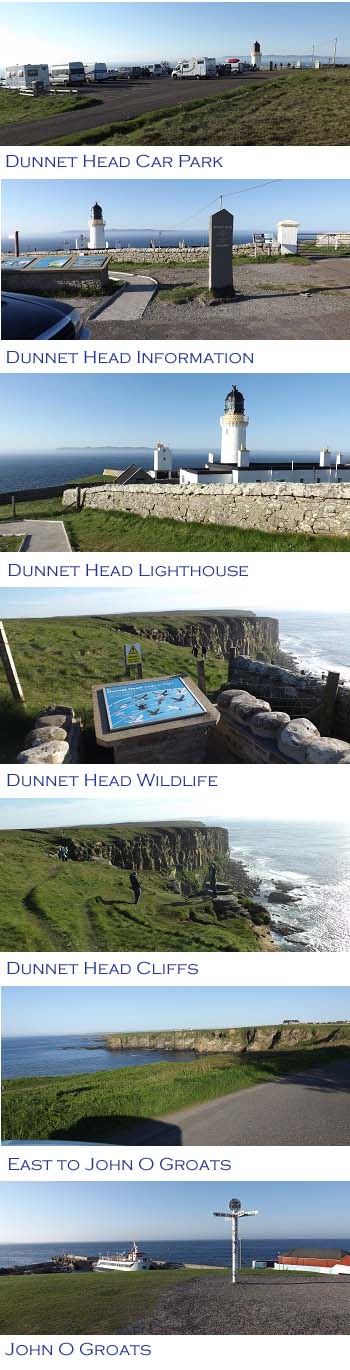
The image top is of the Dunnet Head car park
next to the Lighthouse.
The second image shows the sign stating:
Dunnet Head, Most Northerly Point of Mainland
Britain, Welcome.
The Lighthouse has great views across to the
Orkney Islands, just under 7 miles from this
spot, with the small area the Lighthouse is on
known as Easter Head, with the Lighthouse
sitting 105m / 344ft above sea level.
This area has some violent Storms as vast
amounts of water is forced through this narrow
passage between the Atlantic and North Sea,
with waves over 11m / 36ft, and rocks thrown up
high enough to break windows in the
Lighthouse.
The Cliffs on the west side are much higher
than the east side, a popular area for Photos
with birds such as Puffin, Fulmar, Razorbill,
and Guillemot.
Guillemot are able to dive into the seat at
50 mph / 80 km/h, can reach depths up to 180m /
590ft, well worth watching, they feed on Sand
Eels, Sprats, and Herring.
The Cliffs on the east side are not as high,
but give good views east to John O Groats and
Duncansby Head, furthest northeast point in
Scotland.
The Lochs at Dunnet Head are stocked with
Brown Trout for Angling. Website
Information.
Dunnet Head History
1831 - the Lighthouse was built to designs
of Robert Stevenson, 20m / 66ft high, 105m /
344ft above sea level, with three Lighthouse
Keeper families living there.
1940s - World War 2 installations were here
for Coastal Defense such as a Radar to track
Aircraft, Ships, and Submarines.
There was also an Artillery Range used for
military practice firing, and an Aircraft
Firing Range using the lochs here for training,
not a good time to be fishing for brown
trout.
Coastal Artillery Batteries to protect the
area and the Naval Base at Scapa Flow in
Orkney, were on Islands and headlands in Orkney
and Caithness.
The Defenses were closed at the end of the
War in 1945.
1989 - the Lighthouse was automated.
|