|
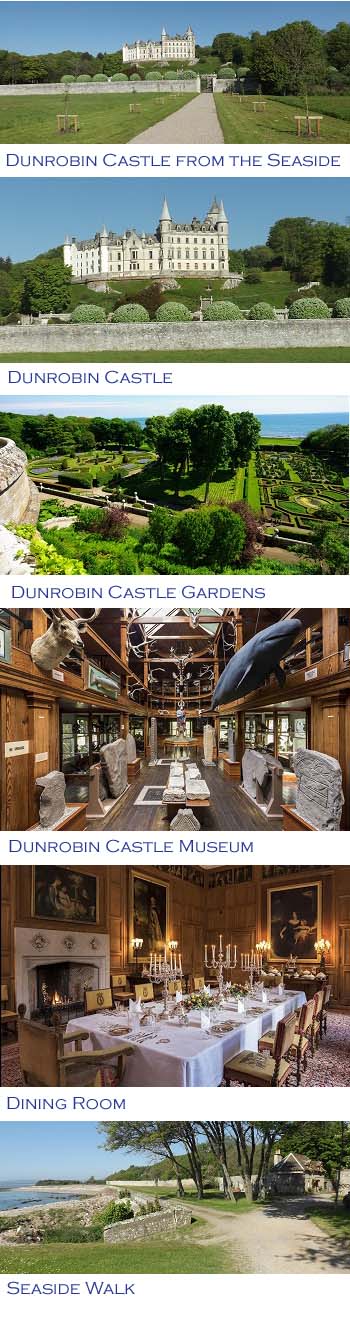
Dunrobin Castle is 53 miles north of
Inverness, 12 miles north of Dornoch, on the
northeast coast of Scotland, built from the
1270s for the Earls of Sutherland, enlarged
from 1835 to 1850.
The Castle, Museum, and Gardens are open for
visits with an entrance fee from 1st April to
31st October, about 10.00am - 17.30pm.
Postcode: KW10 6SF.
For Images on Mobile swipe right
Click On Map for area Attractions
Camping & Touring Parks in
area
The earliest parts of Dunrobin Castle were
built for the Earls of Sutherland from the
1270s, maybe earlier.
The Earls of Sutherland were from Clan de
Moravia / Murray from 1230 - 1508, Clan Gordon
from 1508 - 1785, then the Leveson-Gower family
from 1785 till today.
Dunrobin Castle History
600s? - there is thought to have been a
Wooden Fort on this site built by Picts.
1100s - a Flemish nobleman named Freskin
settled in Scotland during the reign of King
David I. Freskin's descendants were the de
Moravia, a name that changed through time to
Murray, and Sutherland.
1230 - the Earldom of Sutherland was created
for William de Moravia / Murray. The earliest
parts of Dunrobin Castle may have been built
around this time, as William is said to have
died at Dunrobin Castle in 1248.
1401 - the first records of Dunrobin Castle
are made stating it was a Tower House with
walls 6 feet thick.
1508 - the Earldom of Sutherland passed to
the Gordon's through marriage.
1519 - Alexander Sutherland captured the
Castle in an attempt to return the Castle to
the Murray's. After Alexander was captured by
the Gordon's, they cut his head off so it could
be displayed on a pike from the top of the
Castle.
1745 - during the Third
Jacobite Rising, the Jacobite's took
Dunrobin Castle as the Sutherland's were
supporting the British Government. The 17th Earl
escaped Dunrobin, fleeing to Aberdeen where he
joined Government Forces.
1746 - the Jacobite's were defeated at the
Battle of Culloden, last Battle on
the British mainland, leading to more peaceful
times.
1700s late - the more peaceful times led to
many Castles being converted to Mansions, or
Mansions built on the Estate with the Castles
abandoned.
1785 - Elizabeth Sutherland married George
Granville Leveson-Gower, leading to the
Leveson-Gower's becoming the Dukes and
Duchesses of Sutherland, with the lands of
Sutherland being over 1 million acres, largest
private Estate in western Europe.
Her husband also had large Estates and Homes
in England such as Trentham Estate
in Staffordshire, Lilleshall in
Shropshire, Stafford House
at St James in London, Bridgewater
House at Westminster in London, and
Hamilton Place a Townhouse at Hyde Park in
London.
1807 - Elizabeth
Sutherland had about 300 farmers removed to
make way for the first large Sheep Farm in the
area. These acts became known as the Clearances
with thousands of people forced to move to
Towns and Cities, or to Emigrate to Canada,
Australia, New Zealand, and America.
1833 - George Sutherland died at Dunrobin
Castle, was buried at Dornoch Cathedral.
1839 - Elizabeth Sutherland died at Hamilton
Place, Hyde Park in London, England, she was
buried at Dornoch Cathedral.
1835 to 1850 - the 2nd Duke had Dunrobin
Castle remodeled in the Scottish Baronial style
to designs of Sir Charles
Barry. Sir Charles was famous for designing
the Palace of Westminster / House of Commons in
London.
The New Buildings were built around the
original Tower House.
1870 - the Dunrobin Castle Railway Station
was opened as a private station for the Castle.
This Rail Line runs between Inverness and
Thurso.
1900s early, the Sutherland's began hitting
hard times due to cheep imports of Lamb from
Australia, Death Duties, and Acts of Parliament
aimed at splitting up large Estates.
The Sutherland Estate was regarded as the
largest in western Europe at over 1 million
acres in the mid 1800s, reduced to under
400,000 acres by 1919 through land sales, about
120,000 acres in the 2020s.
1915 - during World War I, the Castle was
used as a Naval Hospital.
1965 to 1972 - the Castle was used as a
Boarding School for boys.
1973 - Dunrobin Castle, Museum, and Gardens
were opened to the public. The Sutherland
family still live at the Castle in Private
Accommodation.
2007 - a Clearances Monument was erected at
Helmsdale Village 16 miles north of Dunrobin
Castle.
2025 - Dunrobin Highland
Distillery sold its first bottle of
Gin.
Earls of Sutherland are buried at Dornoch
Cathedral 12 miles south of Dunrobin
Castle, Holyrood Abbey in Edinburgh, and more
recent, in a private Cemetery about 200 yards
north of Dunrobin Castle looking over the
sea.
The Earls of Sutherland and Sinclair, Earls
of Caithness to the north, had many battles
over the centuries, trying to take each others
land, with marriage often used to try and keep
the peace.
See Helmsdale for the story of when the
Sinclair, Earls of Caithness poisoned the Earl
of Sutherland and his wife, for the Clearances
Monument, and how the Sutherland's lost most of
their land.
|